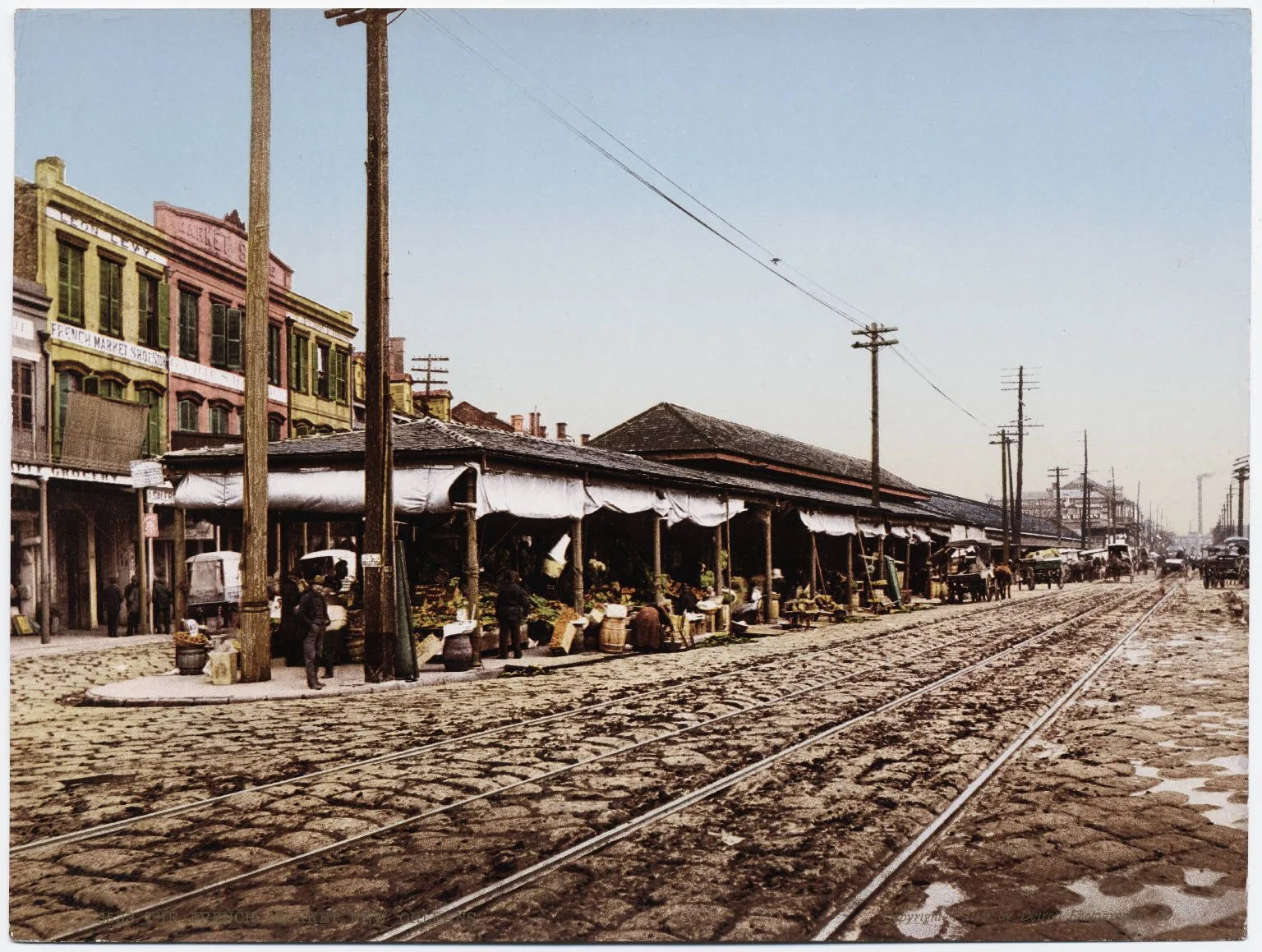
The French Market on a Detroit Photographic Company photochrom from 1900, canvas awnings over the stalls and streetcar tracks in the street. Photochrom: Detroit Photographic Co., public domain
The French Market in New Orleans has been a public market since 1791, when it settled on its present ground along the river below Jackson Square, and people traded on that levee long before the Spanish put up a building. Its oldest structure is the Meat Market of 1813; the market has been wrecked by hurricanes, rebuilt with New Deal money in the 1930s and renovated again in the 1970s. Today it runs from Café du Monde, at the Jackson Square end, down toward Esplanade Avenue and the Old U.S. Mint.
Our blog has had a short piece on the market for years, but it never gave the dates. This one does, and every date traces to a source listed at the end.
If you are reading this on Thanksgiving, the market is the walk for the morning after, and it begins two blocks from our front door.
Who traded on the levee before there was a market?
Picture the riverbank in the 1720s: a few cypress sheds, canoes pulled up on the mud, and women selling fish, gumbo and woven baskets to the settlers of a town that was barely laid out. According to New Orleans Historical, the public history project of the Midlo Center at the University of New Orleans, the market's origins go back to 1675, and after Bienville founded the city in 1718 the Oumas (Houma) and the Tchouchoumas combined their trading grounds on the site of today's market. The Native name for the region was Bulbancha, "the place of many tongues," and the market was where the tongues met.
The Native presence lasted well into the American period. Frederick Law Olmsted, passing through in 1853, counted "pure old Indian Americans" among the Spanish, French, English, Celtic and African crowd, and when Alfred Waud drew the market for Harper's Weekly in July 1871 his notes identified Choctaw women making mosquito netting on one side and selling sassafras, the leaf ground into filé for gumbo, on the other.
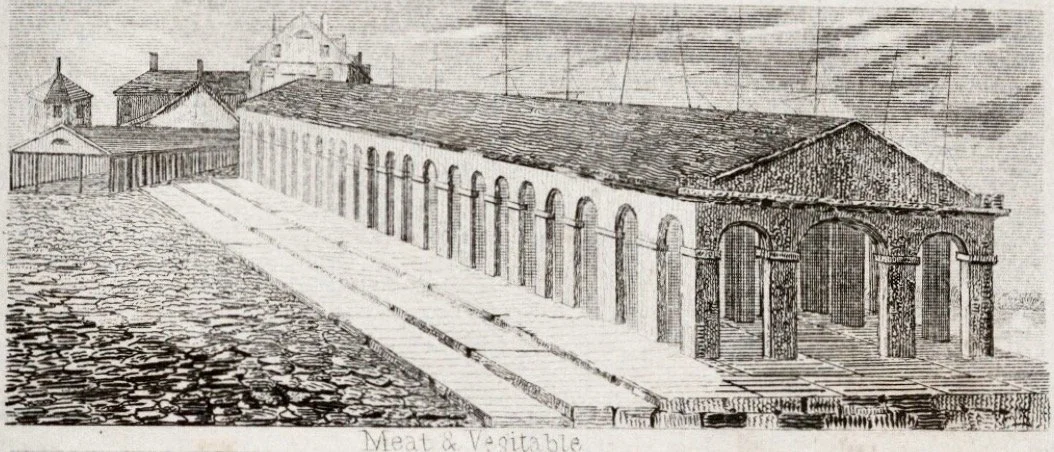
The Meat and Vegetable Market as engraved for Gibson’s Guide in 1838, twenty-five years after the Meat Market was built. Engraving: Gibson’s Guide, public domain
A dated timeline of the French Market, 1779 to 1979
The French Market Corporation, the city body that runs the market, keeps a detailed history on its own site, and most of the dates below are its own.
- 1779 to 1782. The Spanish decide to put the trade under a roof and, around 1782, build the first market house at Chartres and Dumaine. A fire takes it in 1788.
- 1790 to 1791. The market moves to what is now Decatur Street between St. Ann and Dumaine, the ground it still occupies. 1791 is the date the market counts from: it celebrated its bicentennial in 1991, and its site says simply "Since 1791."
- 1812 to 1813. A hurricane destroys the meat sheds in 1812. In 1813 the city builds the Meat Market, the Halle des Boucheries, to a design by City Surveyor Jacques Tanesse, with Gurlie and Guillot as builders; it still stands.
- 1822 to 1833. The next city surveyor, Joseph Pilié, designs the Vegetable Market, built in two phases to 1830. Around 1833 the Red Stores go up between it and the levee.
- 1840. The census first records Rose Nicaud as a free woman of color; she had begun selling coffee while enslaved and kept a stand in the market for decades.
- 1862. The Original Café du Monde Coffee Stand opens in the French Market. It is still there.
- Around 1872. The bazaar that has grown up between the Meat and Vegetable Markets gets its own building, the Bazaar Market, which a hurricane seriously damages in 1915.
- 1884 to 1924. More than a quarter million Italians come through the port, and Sicilian farmers come to dominate the produce trade. In 1906 Salvatore Lupo opens the grocery that becomes Central Grocery at 923 Decatur in 1919.
- August 23, 1932. The market's merchants organize the French Market Corporation. Construction of a new market begins in 1936.
- 1973 to 1979. A second renovation, financed by revenue bonds, adds the Halles des Cuisines; the Farmers' Market is dedicated on April 1, 1975, and the Corporation takes over the Flea Market in 1979.
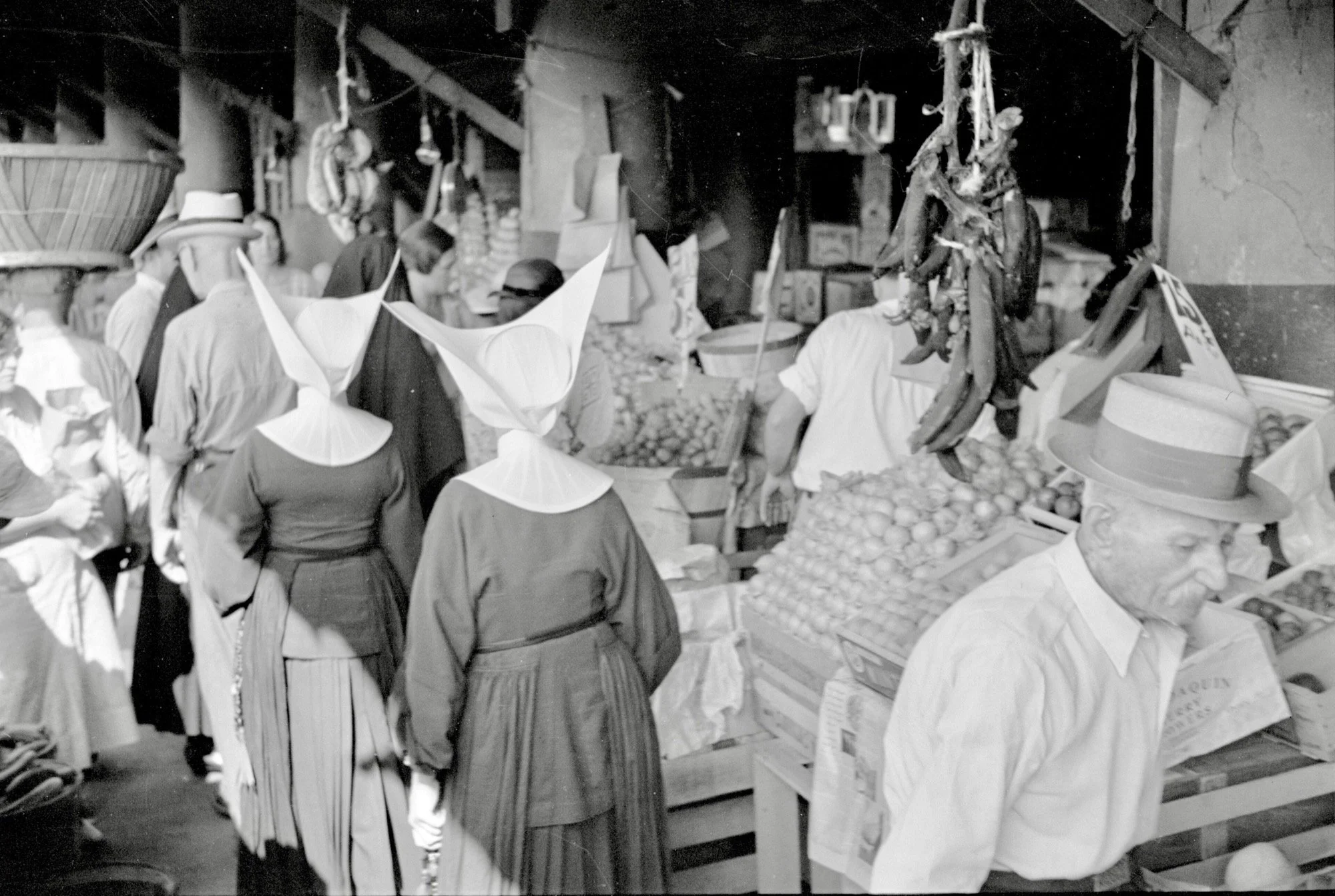
Shoppers in the French Market in June 1936, the year construction began on the New Deal rebuild. Photo: Carl Mydans, FSA, public domain
What did the 1930s and 1970s rebuilds change?
Stand on Decatur Street in June 1936 and you would have seen the old market in its last months: canvas awnings over the stalls, strings of peppers hanging from the posts, nuns and men in straw hats picking over the onions. Construction began that year with Gervais Favrot and Co. as contractor and plans by Sam Stone and Co., paid for by the Corporation, local businesses, the city, the Orleans Levee Board and the federal Public Works Administration. The damaged Bazaar Market was demolished, the Red Stores removed, a new Fruit and Vegetable Market built, and the steel sheds that became known as the Farmers' Market went up beside a wholesale fish shed.
The money ran out before the market did. In 1939 the city repaid the Corporation's debts and became its sole stockholder, and a 1943 lease let the Corporation run the market for fifty years.
The second rebuild came with the Quarter's turn toward visitors. In 1973 the city reorganized the Corporation as a non-profit with a twelve-member board appointed by the mayor and sold 3.2 million dollars in revenue bonds. That renovation added the Halles des Cuisines and a new Red Stores complex, removed the wholesale fish market, dedicated the Farmers' Market in April 1975 and, in 1979, took over the Flea Market.
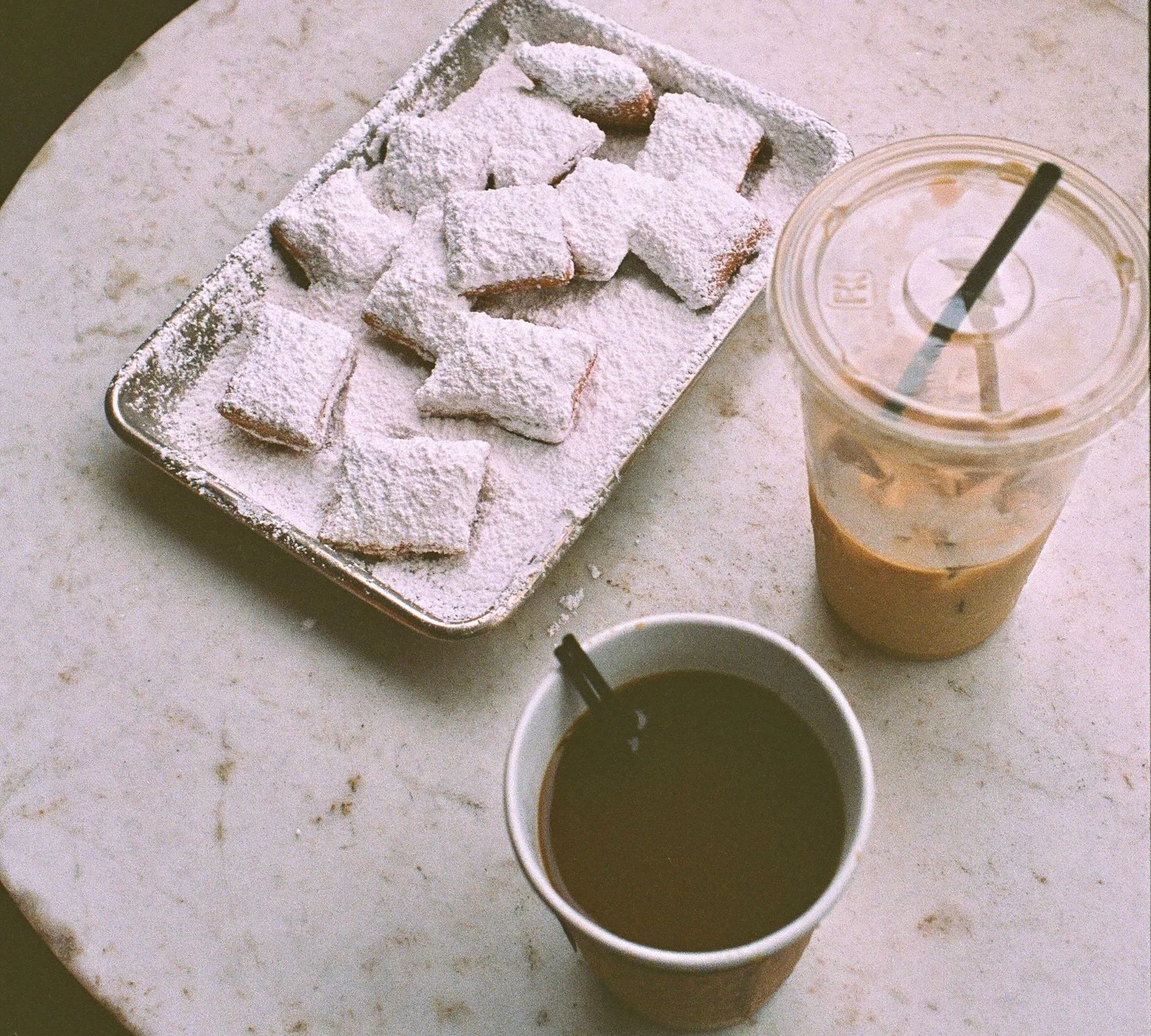
Square beignets under powdered sugar and coffee au lait, the French Market’s oldest surviving menu. Photo: Hamalya Comeau / Pexels
What can you buy and eat at the French Market today?
Start where the market starts. Café du Monde's stand at the Jackson Square end has been there since 1862, in the Fernandez family since Hubert Fernandez bought it in May 1942, and its menu is still mostly dark-roast coffee with chicory, black or au lait, and square beignets under powdered sugar. It closes only on Christmas Day and when a hurricane passes too close, so a Thanksgiving-weekend morning there is safe.
From there the market runs downriver along North Peters Street. When we checked in November 2026, the Corporation's calendar listed:
- The Farmers Market, the historic sheds with eateries and café-style seating, with free concerts: Soulful Sundays at 2 PM and Market Music on Friday afternoons through November.
- The Flea Market, with daily vendors selling art, crafts and souvenirs, in the sheds beyond.
- Dutch Alley at 916 North Peters, where New Orleans Jazz National Historical Park performs and Johnette Downing's free Family Music Series plays on the first Friday of the month.
- Farm to Table weekend, November 21 and 22, 2026, when Ranatza Farms brings seasonal produce back to the sheds, and the holiday tree lighting in Oscar Dunn Park on Wednesday, December 2.
Across Decatur Street, Central Grocery at 923 Decatur is the muffuletta's home, a third-generation Sicilian grocery run by Tommy and Frank Tusa. Hurricane Ida brought a neighbor's wall down on it in August 2021; rebuilt on new piers, it was back behind its counter when we checked in November 2026. At the Esplanade end, the Old U.S. Mint at 400 Esplanade Avenue, completed in 1838, houses the New Orleans Jazz Museum, and the combined visitor center for Jean Lafitte National Historical Park and the Jazz park is at 419 Decatur.
Plan Your Visit
- Go early. The Picayune's 1900 guide said the market opened at 5 AM and Sunday morning was the hour to see it. The sheds open mid-morning now, and the produce and the light are both better before noon.
- Walk it from the river end. Start at Café du Monde, follow the sheds down North Peters and finish at the Old Mint, two blocks from our door. Our walking guide to Esplanade Avenue picks up where the market ends.
- Bring a bag for the Farmers Market and a kitchenette to cook in. Every unit at Jean Lafitte House has one, which is why our guests come home from the market with more than pralines.
- Make a holiday of it. The market is on the way to the Réveillon dinners in our guide to Réveillon in New Orleans, and the tree lighting is December 2.
Frequently Asked Questions
When was the French Market in New Orleans founded? The market counts from 1791, when it settled on its present site on Decatur Street; the Spanish had built an earlier market house around 1782, and Native nations traded on the levee long before that.
What is the oldest building in the French Market? The Meat Market, or Halle des Boucheries, built in 1813 to a design by City Surveyor Jacques Tanesse after a hurricane destroyed the earlier sheds in 1812.
Is Café du Monde part of the French Market? Yes. The Original Café du Monde Coffee Stand was established in the French Market in 1862 and still anchors the Jackson Square end.
Who rebuilt the French Market in the 1930s? The French Market Corporation, organized by the market's merchants in 1932, with construction beginning in 1936 and funding from the city, the Levee Board, local businesses and the federal Public Works Administration.
Stay Where the Avenue Meets the Market
The market has outlived the Spanish crown, the hurricanes of 1812 and 1915, a Civil War and two complete rebuilds, and it still sells coffee on the ground where the Houma sold fish. Walk it on a cool morning and carry something you can cook back up Esplanade Avenue.
Every unit at Jean Lafitte House has a kitchenette, our rooms sleep two to six, and there is a courtyard with a pool. The market is near where the avenue begins. Book your stay at Jean Lafitte House.