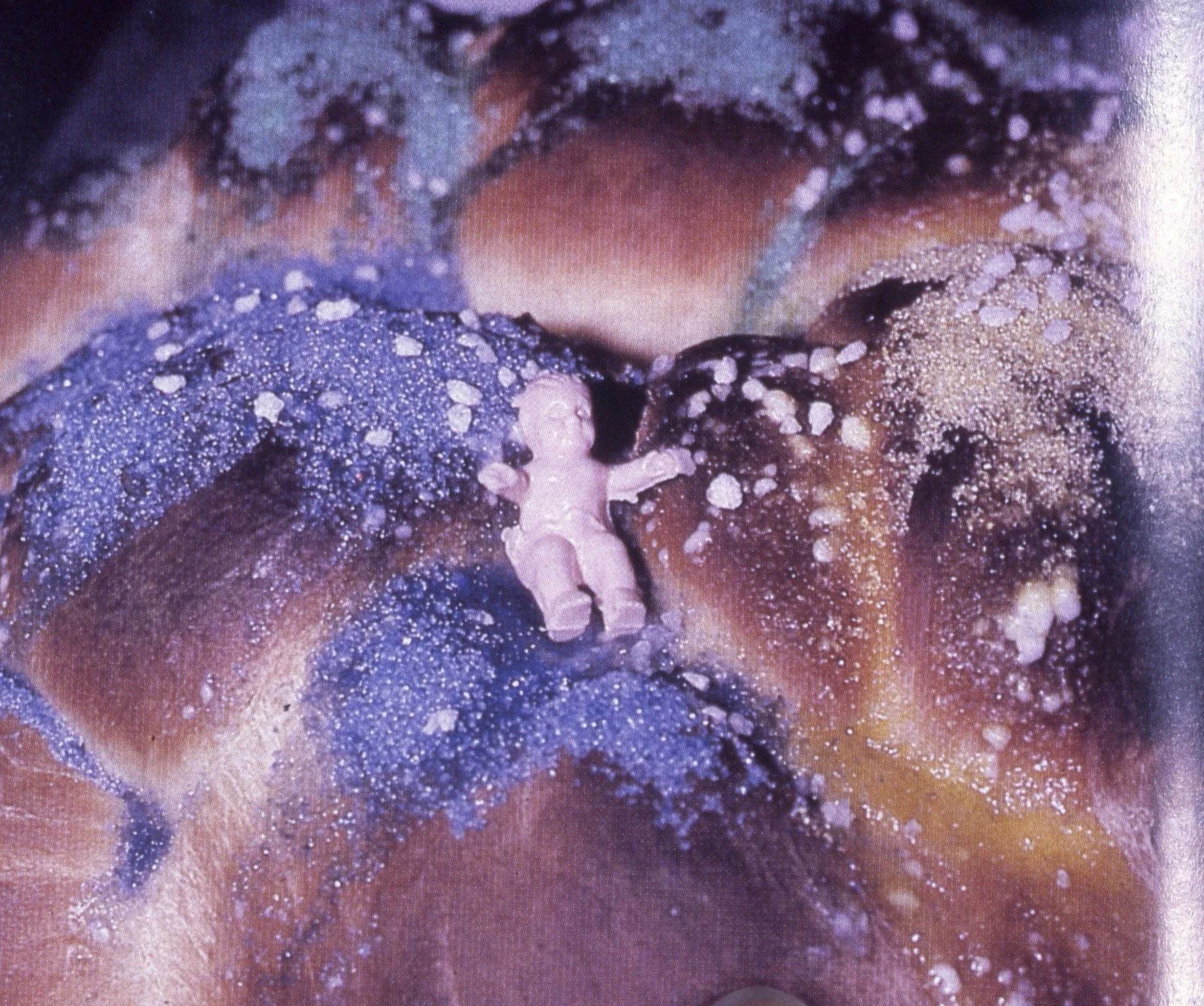
A New Orleans king cake photographed for the National Park Service in 1983, the plastic baby in plain sight. Photo: Sydney Byrd / NPS, public domain
King cake history begins in medieval Europe, where Catholics marked Epiphany on January 6 with an almond pastry that hid a bean, and the person who found the bean was crowned king for the night. French settlers carried the custom to Louisiana, a Carnival krewe put a gold bean in a cake in 1871, and a New Orleans bakery swapped the bean for a tiny doll in the twentieth century. The result is the oval, cinnamon-scented brioche under purple, green and gold sugar that the city eats from Twelfth Night to Mardi Gras.
The 2027 season opens on Wednesday, January 6, 2027, and ends on Mardi Gras Day, Tuesday, February 9, 2027. The New Orleans tourism bureau estimates that more than 500,000 king cakes are sold in the metro area each Carnival, and about 50,000 of them are shipped out of state.
What is a king cake, and where does it come from?
Picture a Flemish dining room around 1640, as Jacob Jordaens painted it: a fat old man in a paper crown lifts his glass and the whole table roars "the king drinks!" He is the Bean King. He found the bean in the Epiphany cake, and for one night the household obeys him.
That is the custom the king cake grew out of. Across Catholic Europe, January 6, Epiphany or Twelfth Night, was the day the Three Kings reached the manger and the day Carnival began. France had its galette des rois, Spain its roscón de reyes, England its Twelfth Cake, and each hid a prize that made the finder king or queen of the party.
France still eats two versions. In the north, the galette des rois is a round of puff pastry filled with frangipane, an almond cream. In Provence, where puff pastry was hard to keep in a warm kitchen, bakers made the gâteau des rois instead: a ring of brioche scented with orange-flower water and studded with candied fruit. The charm is still called the fève, "bean," though porcelain fèves have been made in Limoges since 1875. Liz Williams, founder of the Southern Food and Beverage Museum, says the brioche gâteau is the version New Orleans took to heart, because so many of its settlers came from southern France.
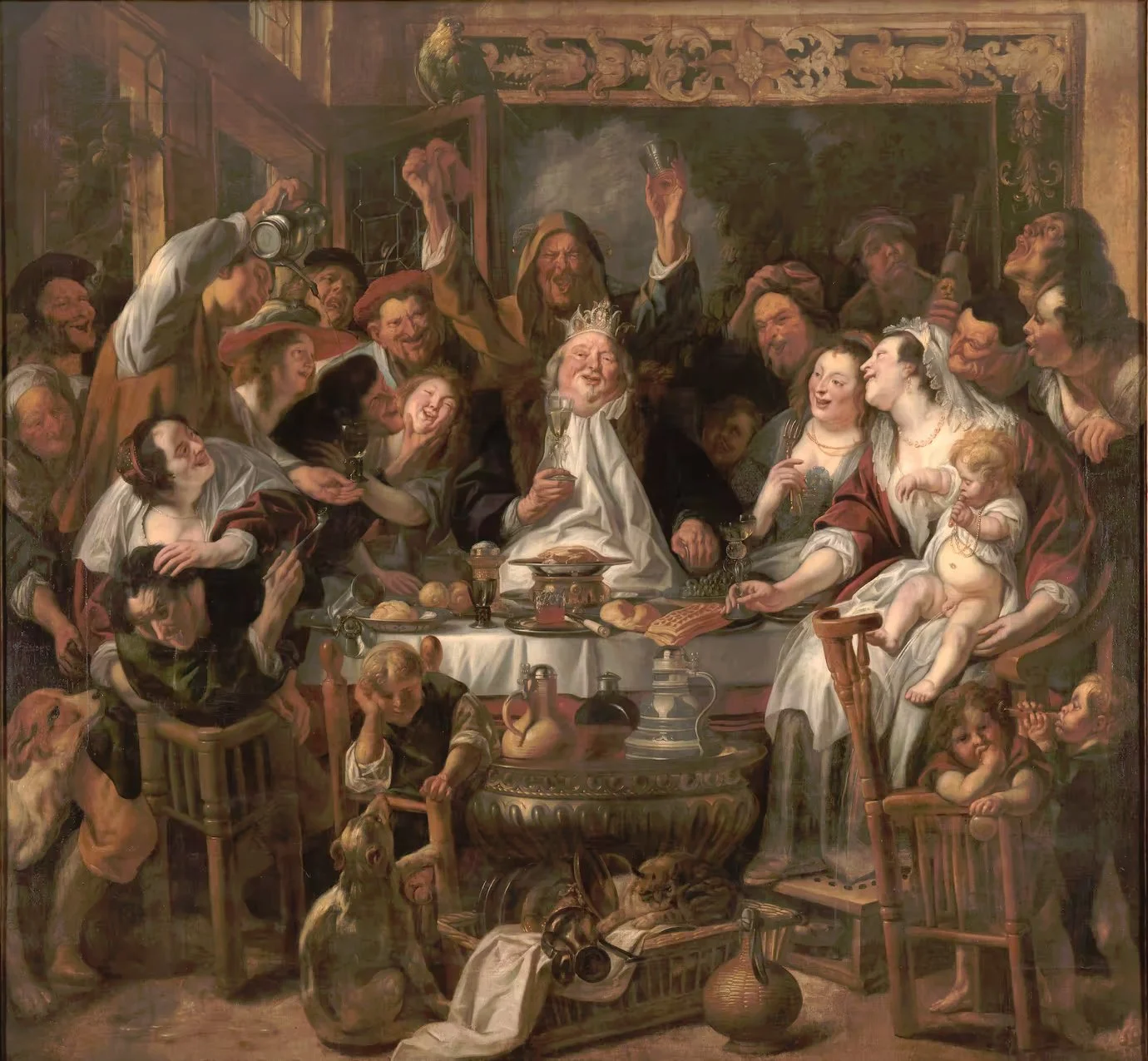
Jordaens’ “The Bean King” shows the Twelfth Night game the king cake came from: find the bean, wear the crown. Painting: Jacob Jordaens, c. 1638, public domain
How did a Twelfth Night ball start the New Orleans king cake?
The Creole families of early New Orleans kept Twelfth Night, le Jour des Rois, at home, with a cake and a bean. The cake became a public institution on January 6, 1870, when a new krewe called the Twelfth Night Revelers paraded to the French Opera House and held a ball led by a Lord of Misrule. They were only the second parading krewe in the city, thirteen years after Comus, and they gave Carnival its opening night.
The bean came out the next year. At the 1871 ball the young women of the court were served slices of a large cake hiding one gold bean and several silver ones. Emma Butler found the gold bean and became the first queen of a New Orleans Carnival ball; the silver beans named her maids. The Revelers stopped parading after 1878, but the ball never stopped: the krewe still draws its queen on January 6, today from a wooden replica cake with little drawers for the beans.
Two more pieces fell into place in the same decade:
- 1872. The Rex Organization staged its first daytime parade and adopted purple, green and gold as its royal colors. Rex's own history says the founders never explained the choice; the familiar meanings came in 1892, when a Rex parade themed "The Symbolism of Colors" assigned justice to purple, faith to green and power to gold.
- 1887. The words "king cake" first appeared in the Daily Picayune, according to historians Anthony Stanonis and Rachel Wallace, gradually replacing "Twelfth Night cake" and the French names. "King cake parties" followed, with the finder of the bean obliged to host the next one.
By the 1910s bakeries were advertising king cakes from Epiphany through Mardi Gras, and between the wars the cake settled into its oval, crown-like shape and took on Rex's colors in sugar. The cake that had belonged to Twelfth Night now belonged to the whole season; our history of Mardi Gras in New Orleans picks the story up from here.
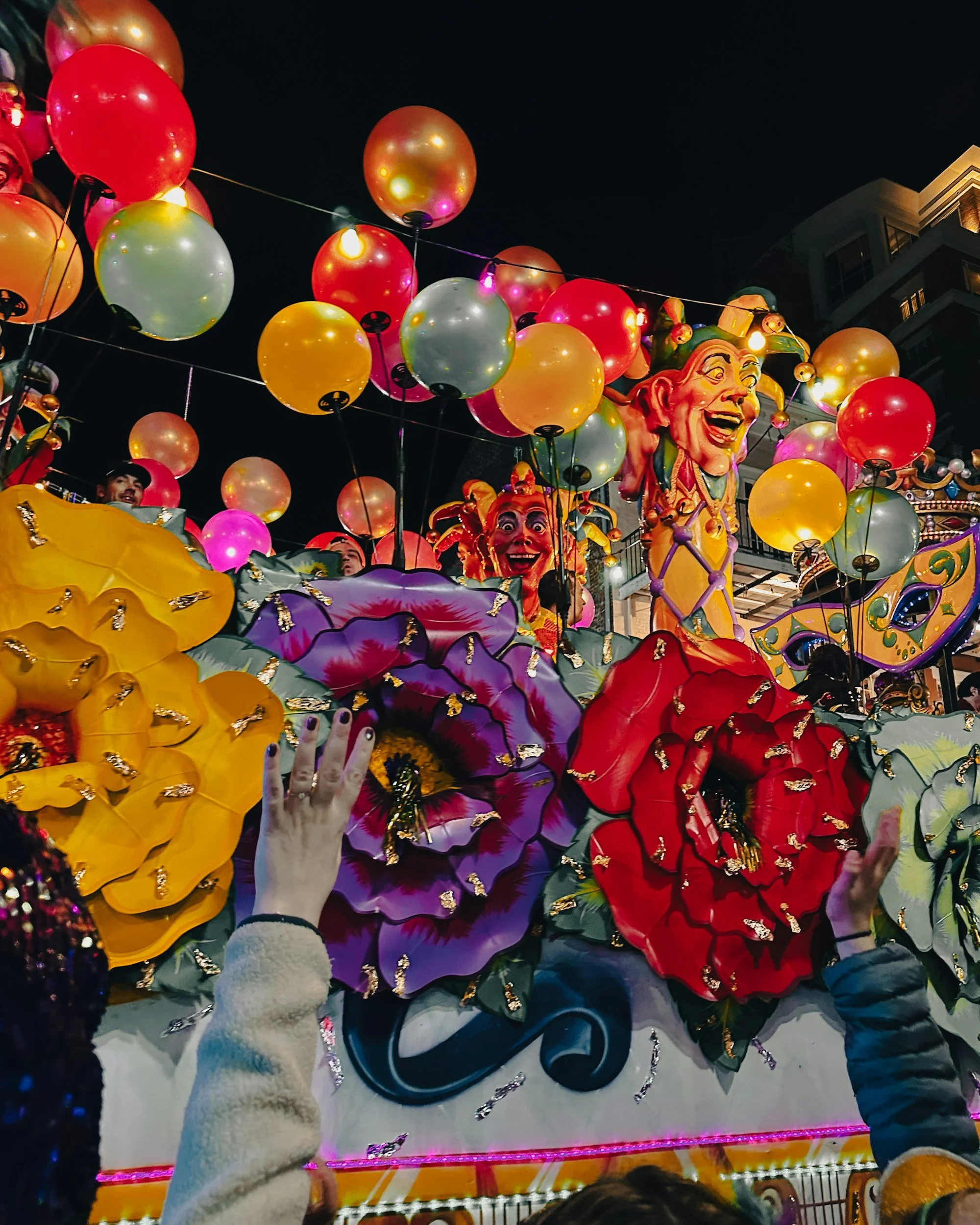
Purple, green and gold have been Carnival’s colors since Rex’s first parade in 1872; the meanings came twenty years later. Photo: Katie Mont / Unsplash
Why is there a baby in the king cake?
The short answer is a salesman with too many dolls. Donald Entringer ran McKenzie's, one of the largest commercial bakeries in twentieth-century New Orleans. As food historian Poppy Tooker tells it, a traveling salesman turned up with an overstock of tiny French porcelain dolls and suggested baking them into king cakes. Entringer later said he had used the china dolls since the late 1930s; McKenzie's was advertising a "China Doll" cake by 1952, and when the porcelain ran out he bought plastic babies from an importer in the French Quarter. By the 1960s the plastic baby was the rule, and every other bakery followed.
Porcelain figures had turned up in New Orleans cakes before McKenzie's; Entringer did not invent the idea so much as sell it, hard, across the city. What the baby means is tradition rather than record. Many will tell you it represents the Christ child found by the Magi; the historians who have read the bakery advertisements say its spread had more to do with marketing than devotion, and Entringer never claimed a religious motive. What everyone agrees on is the rule: whoever gets the baby buys the next cake.
Brioche or filled: which king cake is the real one?
Both, depending on the decade. The traditional New Orleans king cake is a cinnamon brioche, braided into an oval, with colored sugar on top; until the 1970s the sugar went straight onto the dough, and icing came after. Cream cheese and fruit fillings arrived in the 1980s, when, as one baker put it, customers wanted anything that could go in a pie.
The cousins are worth meeting too. Spain's and Mexico's rosca de reyes is a brioche ring with candied fruit, very close to the Provençal gâteau des rois and to the plain New Orleans cake before the sugar went on. Whichever you bring home, every one of our rooms has a kitchenette, and a king cake is meant to be cut at home, with coffee, the baby hidden before the first slice.
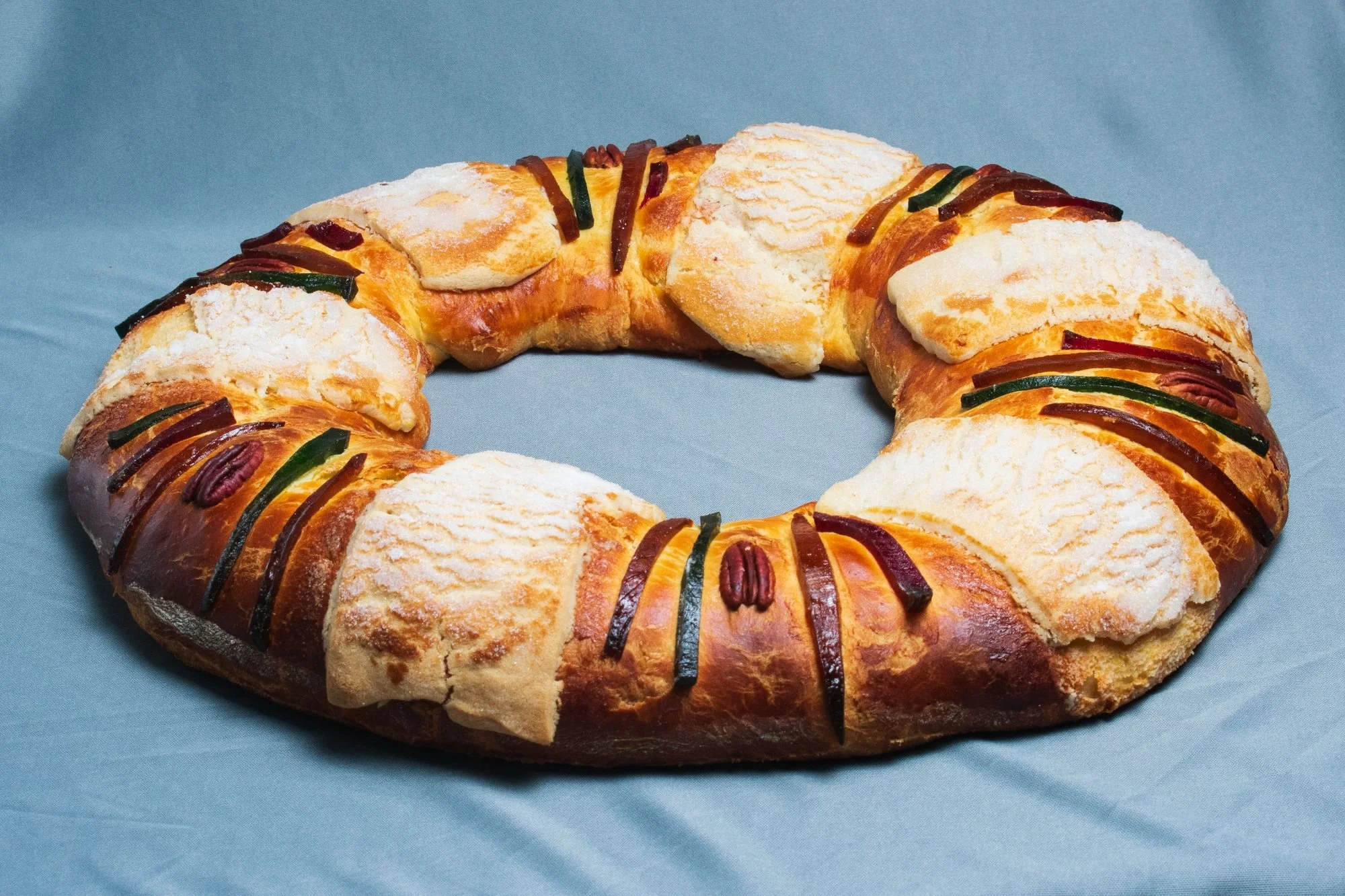
A rosca de reyes, the Spanish and Mexican Epiphany ring: brioche and candied fruit, like the Provençal gâteau des rois the New Orleans cake grew from. Photo: Erick Ortega / Pexels
When is king cake season in 2027, and where do you get one?
Carnival 2027 runs from Twelfth Night, January 6, to Mardi Gras, February 9, 2027, a short season of five weeks, since Mardi Gras falls 47 days before Easter. Most bakeries sell king cake only in that window. When we checked in November 2026, these bakeries were open and had king cakes in their 2026 lineups:
- Dong Phuong Bakery, Chef Menteur Highway in New Orleans East. Founded in 1982 and honored with a James Beard America's Classics award in 2018, it makes the cake the city lines up for; pre-orders sell out, and it ships nationwide.
- Manny Randazzo King Cakes, Metairie. A second-generation baker working from the recipe of the family's 1965 Chalmette bakery; its 2027 shipping calendar opens after December 27, 2026.
- Haydel's Bakery, Jefferson Highway. Baking in New Orleans since 1959 and shipping nationwide; it has long had a porcelain collectible made for its cakes, a nod to McKenzie's china dolls.
- Gambino's Bakery, since 1949, with more than 100,000 orders shipped nationwide.
- Bywater Bakery, Dauphine Street in the Bywater, a neighborhood bakery opened in 2017 whose king cakes were served at The Historic New Orleans Collection's King Cake Kickoff on January 9, 2026.
The Collection's shop on Royal Street sells king cakes from January 6; we will note the 2027 tasting date when it is announced.
Plan Your Visit
- Come for Twelfth Night itself. On January 6 the Krewe de Jeanne d'Arc walks through the French Quarter and the Phunny Phorty Phellows ride the St. Charles streetcar to declare Carnival open. The Quarter begins at our front door.
- Order ahead. The best-known bakeries take pre-orders and sell out; several ship.
- Pair it with the rest of the winter table. Our posts on the Réveillon dinner and the Sazerac cover the Creole traditions on either side of Twelfth Night.
- Book early for the last two weekends. The parades of the final days before Mardi Gras, February 9, 2027, bring the city's busiest nights of the year.
Frequently Asked Questions
When does king cake season start in 2027? On Twelfth Night, January 6, 2027, the first day of Carnival. It ends on Mardi Gras Day, February 9, 2027.
Why is there a baby in a king cake? McKenzie's Bakery began using tiny porcelain dolls after a salesman offered a surplus of them, then switched to plastic babies that became the rule by the 1960s. Many say the baby represents the Christ child; whoever finds it buys the next cake.
What do the king cake colors mean? Purple for justice, green for faith and gold for power, meanings assigned by the Rex parade of 1892. Rex has used the three colors since its first parade in 1872.
What is the difference between a galette des rois and a king cake? The galette is a round of puff pastry filled with almond cream; the New Orleans king cake descends from the Provençal gâteau des rois, a brioche ring with candied fruit.
Can you get king cake outside of Carnival season? A few bakeries sell it year-round, but most make it only from January 6 to Mardi Gras, and tradition calls eating it out of season bad luck.
Bring the King Cake Home to Esplanade Avenue
Twelfth Night was kept in the Creole houses of Esplanade Avenue long before there was a krewe to parade it: a brioche ring, a bean inside, and a king until morning. Our building dates from the early 1800s, and its upper rooms open onto shared balconies over the avenue.
Our rooms sleep two to six, each with a kitchenette for the cake you bring home. Book your stay at Jean Lafitte House for the start of the season.